
Everything You Need to Know About SPF
Your no-nonsense guide to sunscreen, UVA, UVB and healthier-looking skin
If you buy only one skincare product consistently, make it sunscreen. SPF is not just for beach holidays or hot weather. UV exposure can happen in the UK, on cloudy days and during everyday life.
Used properly, sunscreen helps reduce sunburn and UV damage. It also supports any skincare plan aimed at preventing premature skin ageing and uneven pigmentation.
The Daily Step Your Skincare Routine Cannot Replace
The best SPF is one you will apply generously, wear consistently and reapply when needed.
What Does SPF Actually Mean?
SPF stands for Sun Protection Factor. It mainly describes protection against UVB, the ultraviolet radiation most associated with sunburn. A higher number offers greater UVB protection when the product is applied in the tested amount.
SPF is not a timer and SPF 50 does not mean you can stay in the sun fifty times longer. Sweat, water, rubbing and under-application all reduce real-world protection.
UVA vs UVB: You Need Protection From Both
UVB is a major cause of sunburn. UVA penetrates more deeply and contributes to premature skin ageing; both can damage skin and contribute to skin cancer risk.
Choose a broad-spectrum sunscreen. In the UK, look for at least SPF 30 plus 4- or 5-star UVA protection. A UVA symbol inside a circle also indicates recognised UVA protection.
Should You Choose SPF 30 or SPF 50?
SPF 30 is the minimum recommended by the NHS. SPF 50 or 50+ may be a sensible choice if you burn easily, have a history of sun damage, use medication that increases photosensitivity, have a pigmentation concern, or expect prolonged or intense exposure.
Do not let a higher number create false confidence. SPF 50 applied too thinly may protect less effectively than SPF 30 applied properly.
How Much Sunscreen Should You Apply?
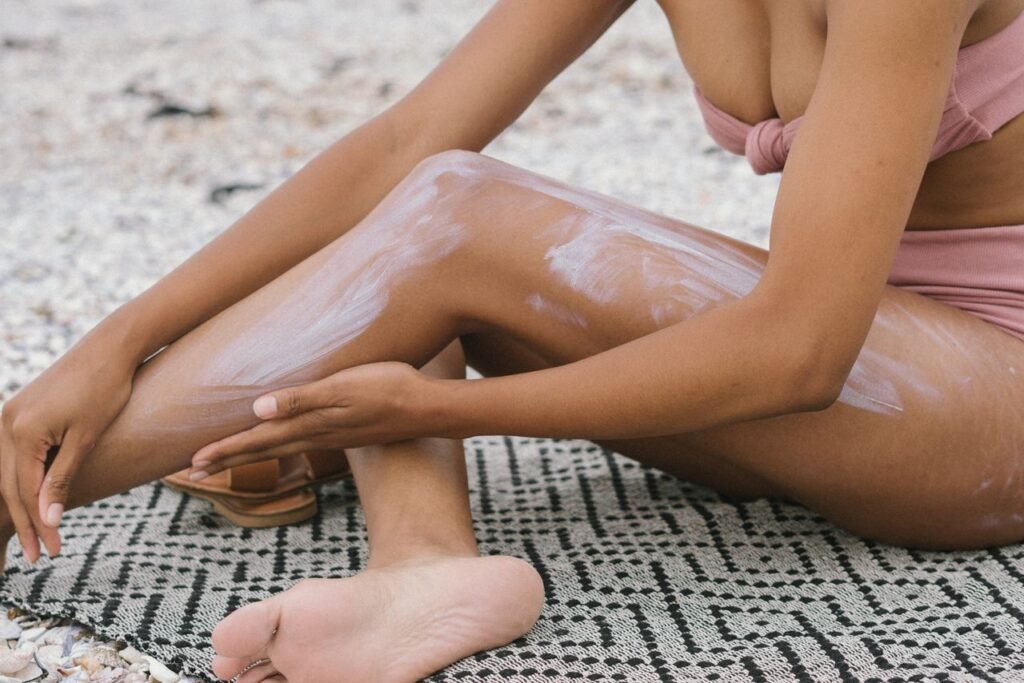
Most people do not apply enough. The NHS advises approximately 6 to 8 teaspoons for the whole adult body. Apply it to all exposed areas, including the face, neck, ears, hairline, chest, hands and any thinning areas of scalp.
For the face and neck, use enough to create an even film. The popular “two-finger” guide can be a useful starting point, but packaging, nozzle size and face size vary – complete, even coverage matters more than a social-media rule.
When and How Often Should You Reapply?
If you will be outdoors long enough to risk burning, NHS guidance recommends applying sunscreen 30 minutes before going out and again just before you leave.
Reapply generously and frequently according to the label – commonly every two hours while exposed. Reapply immediately after swimming, towel drying, heavy sweating or rubbing, even when the product is labelled water-resistant.
Do You Need SPF Every Day in the UK?
Make SPF part of your morning routine when UV exposure is likely, particularly when the UV index is 3 or above. Daily facial sunscreen is also a practical choice for anyone focused on preventing photoageing or managing pigmentation.
UV intensity varies with the season, time, altitude, cloud cover and reflection from water, sand, snow and concrete. Check the UV index instead of judging risk by temperature.
Does Makeup With SPF Count?
Makeup containing SPF can add protection, but most people do not apply foundation or powder in the quantity needed to achieve the labelled SPF. Use a dedicated sunscreen as your main layer and treat SPF makeup as a bonus, not a substitute.
Allow sunscreen to settle before applying makeup. For outdoor days, reapplication still matters; SPF mist, cushion or powder may be convenient, but they must provide adequate and even coverage.
Mineral or Chemical Sunscreen: Which Is Better?
Both can work well. So-called mineral filters, such as zinc oxide or titanium dioxide, and organic filters both reduce UV reaching the skin through a combination of absorption, reflection and scattering.
The practical choice depends on comfort, skin sensitivity, finish, white cast, water resistance and whether you will use enough. Sensitive or sting-prone skin may prefer fragrance-free formulas. Acne-prone skin may prefer a lightweight, non-comedogenic product.
SPF for Brown and Black Skin
Melanin offers some natural protection, but it does not make skin immune to UV damage or skin cancer. Every skin tone can burn and develop UV-related damage.
For darker skin tones, an invisible or tinted formulation may reduce white cast and improve consistent use. Sun protection is also important when managing dark marks and uneven pigmentation.
Can Sunscreen Cause Vitamin D Deficiency?
Do not deliberately burn or avoid sun protection to obtain vitamin D. The NHS advises balancing sun protection with vitamin D needs. Some groups are advised to consider a daily vitamin D supplement, especially during autumn and winter; ask a pharmacist or GP for advice relevant to you.
Common SPF Myths – Busted
“I only need SPF when it is sunny.” False. UV can still reach skin on cloudy days.
“My moisturiser and foundation both contain SPF, so the numbers add together.” False. SPF 15 plus SPF 30 does not equal SPF 45.
“A base tan protects me.” False. There is no safe or healthy way to tan, and a tan does not prevent further UV damage.
“Water-resistant means waterproof.” False. Reapply after swimming, sweating and towel drying.
“Once in the morning is enough.” Not during prolonged outdoor exposure. Reapplication is essential.
Where Does SPF Fit in Your Skincare Routine?
In the morning, sunscreen is normally the final skincare step and is applied before makeup. A simple order is: cleanse, treatment serum if used, moisturiser if needed, then sunscreen.
Do not mix sunscreen into moisturiser or foundation, because this may interfere with the even protective film. Layer products and allow each one to settle.
The Smart SPF Checklist
- At least SPF 30
- At least 4-star UVA protection or UVA-in-a-circle symbol
- A texture you will apply generously
- Water resistance for swimming or heavy sweating
- Within its expiry date and period-after-opening limit
- Reapplied during continued exposure
Protect More Than Your Face
Sunscreen is only one part of sun safety. Seek shade, wear protective clothing, use a wide-brimmed hat and wear suitable sunglasses. In the UK, take particular care between 11am and 3pm from March to October. Babies under six months should be kept out of direct strong sunlight.
If you notice a new or changing mole, growth, lump or patch of skin, contact your GP rather than attempting to treat it cosmetically.
SPF FAQs
What does SPF actually mean?
Should I choose SPF 30 or SPF 50?
How much sunscreen should I apply?
Do I need SPF every day in the UK?
Does makeup with SPF count?
Can sunscreen cause vitamin D deficiency?
Where does SPF fit in my skincare routine?
Your SPF Plan at Nidhi Aesthetics, Blackpool
Skincare does not need to be complicated, but it does need to be consistent. At Nidhi Aesthetics, we can help you build a practical routine around your skin type, concerns and lifestyle.
Looking for personalised skincare advice in Blackpool? Contact Nidhi Aesthetics to arrange a consultation.
This guide provides general information and does not replace individual medical advice. Product suitability varies. Seek professional advice for allergies, skin disease, photosensitising medicines or concerning skin changes.
Your SPF Plan at Nidhi Aesthetics
Looking for personalised skincare advice in Blackpool? Contact Nidhi Aesthetics to arrange a consultation.
Book an Appointment